Agile Glossary

Niko-niko Calendar

What is Niko-niko Calendar?

The team installs a calendar on one of the room’s walls. The format of the calendar allows each team member to record, at the end of every workday, a graphic evaluation of their mood during that day. This can be either a hand-drawn “emoticon”, or a colored sticker, following a simple color code, for instance: blue for a bad day, red for neutral, yellow for a good day. Over time, the niko-niko calendar reveals patterns of change in the moods of the team, or of individual members.
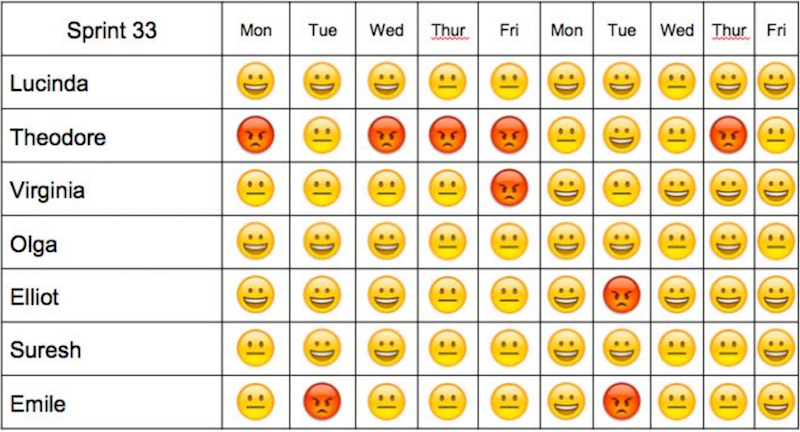
Picture from Portfolio Visualization and Prioritization for Business Agility – Workshop

Also Known As

The Japanese word “niko” means “smile”; following a common pattern of word doubling in Japanese, “niko-niko” has a meaning closer to “smiley”. The term “mood board” is also seen. It is an information radiator.

Expected Benefits

The value of this practice lies in making somewhat objective an important element of team performance – motivation or well-being – which is generally seen as entirely subjective and thus impossible to measure and track. This may be seen as an illustration of the Gilb Measurability Principle: “anything you need to quantify can be measured in some way that is superior to not measuring it at all.” In other words, a measurement does not have to be perfect or even very precise, as long as your intent is to get a quantitative handle on something that was previously purely qualitative; the important thing is to take that first step toward quantifying.

Common Pitfalls

As with other activities, such as retrospectives, where team members are asked to report subjective feelings, self-censorship is always a risk. This could be the case, for instance, if team members who report poor days are blamed for “whining”, by management or by teammates.

Origins

  • 2001: among the visualizations described in Norm Kerth’s “Project Retrospectives”, the “Energy Seismograph” can perhaps be seen as a forerunner of the niko-niko calendar
  • 2006: niko-niko calendars are first described by Akinori Sakata in this Web article
Thank you to our Annual Partners​

Join us today!

Agile Alliance offers many online and in-person events and workshops for our members. If you’re not currently a member, you can join now to take advantage of our many members-only resources and programs. LEARN MORE >

Get the latest Agile news!

  • This field is for validation purposes and should be left unchanged.

By subscribing, you acknowledge the Agile Alliance Privacy Policy, and agree to receive our emails.

Additional Agile Glossary Terms

Collective code ownership is the explicit convention that every team member can make changes to any code file as necessary: either to complete a development task, to repair a defect, or to improve the code's overall structure.
In an Agile context, Incremental Development is when each successive version of a product is usable, and each builds upon the previous version by adding user-visible functionality.
A basic task board is divided into three columns labeled "To Do," "In Progress," and "Done." Cards are placed in the columns reflecting the current status.
The scrum master is the team role responsible for ensuring the team lives agile values and principles and follows the processes and practices that the team agreed they would use.
Refactoring consists of improving the internal structure of an existing program's source code, while preserving its external behavior.
Class Responsibility Collaborator (CRC) Cards are an object oriented design technique teams can use to discuss what a class should know and do and what other classes it interacts with.
The Kanban Method is a means to design, manage, and improve flow systems for knowledge work. The method also allows organizations to start with their existing workflow and drive evolutionary change. They can do this by visualizing their flow of work, limit work in progress (WIP) and stop starting and start finishing.

Help us keep the definitions updated

Ready to join Agile Alliance?

Unlock members-only access to online learning sessions, Agile resources, annual conference discounts, and more! And when you join, you’ll be supporting our member initiatives, regional events, and global community groups.

Privacy Preference Center

IMPORTANT: We have transitioned to a new membership platform. If you have not already done so, you will need to SET UP AN ACCOUNT on the new platform to establish your user profile. Your previous login credentials will not work until you do this set up.

When you see the login screen, choose “Set up Account” and follow the prompts to create your new account. You can choose to log in using your social credentials for either Google or Linkedin (recommended), or you can set up your account using an email address.