This Agile case study is drawn from the Agile Experience Report “Inventing and Implementing ‘The Scrum Master Dilemma Game'” by Charlotte Frandsen.
Nykredit, a Danish financial institution with an Agile IT organization of nearly 40 teams, faced growing ambiguity around the Scrum master role. Although Scrum and Kanban were widely used, Scrum masters interpreted their responsibilities differently. Some acted like project managers while others functioned mainly as facilitators.
As the company pushed toward more self-managing teams, Scrum masters needed stronger informal leadership skills. To address this, Nykredit created a Scrum master Dilemma Game. The card-based tool used real scenarios from Scrum masters’ daily work to prompt discussion and reflection.
The game created a practical way for Scrum masters to learn from each other, build confidence handling leadership dilemmas, and develop a shared understanding of the role.
The Challenge
Nykredit’s IT organization included about 40 Agile teams supported by 28 Scrum masters and two Agile Coaches. While the organization wanted teams to handle issues internally, Scrum masters often struggled to lead difficult conversations without formal authority.
Common dilemmas included:
- Addressing disruptive behavior within teams
- Balancing team autonomy with stakeholder expectations
- Providing direct feedback while maintaining trust
- Handling leadership situations without clear role boundaries
Without a structured way to share experiences, Scrum masters handled these situations inconsistently. The organization needed a method to develop leadership judgment across the community.
The Approach
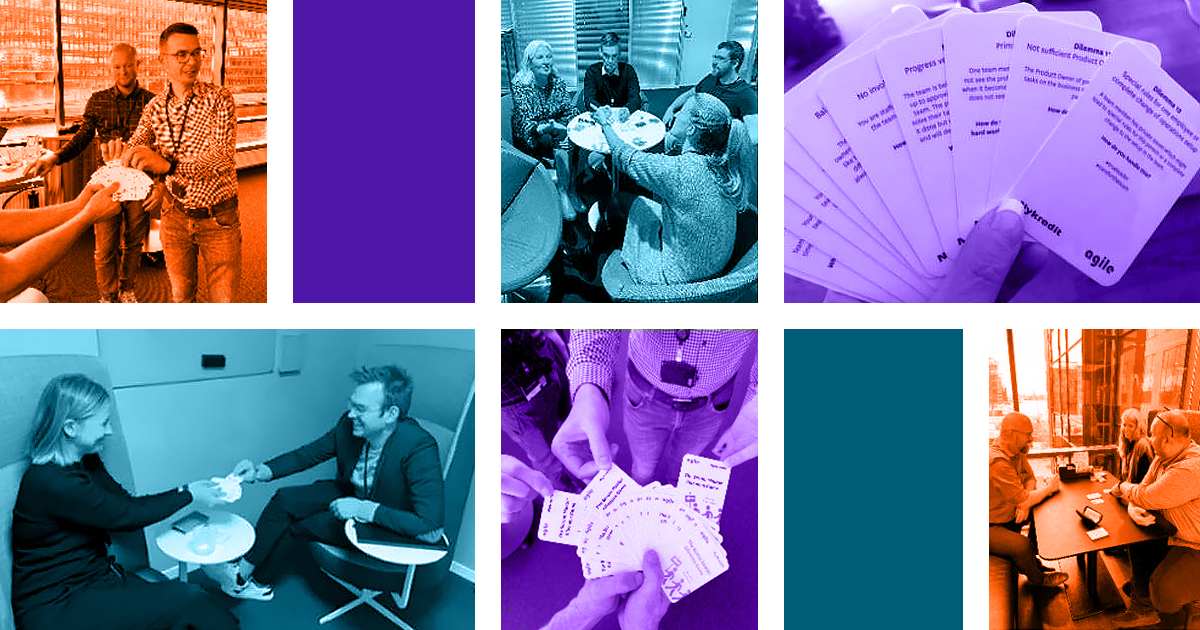
The Agile department chose a simple solution: a gamified discussion tool. The Scrum Master Dilemma Game presented real workplace situations on cards and asked participants to discuss how they would respond.
The goal was not to provide correct answers but to encourage reflection and peer learning. The discussions drew on ideas already used within the organization, including Radical Candor and trust-building practices for high-performing teams.
The approach focused on shared learning rather than formal training.
Implementation and Iteration
The game began during a mini-hackathon where Scrum masters and Agile Coaches developed a prototype. Afterward, the team gathered real dilemmas from the Scrum master community and used them to build a minimum viable product.
The MVP included 21 dilemma cards. Each card contained a scenario and a discussion question.
The game was released in October 2022 during a department gathering attended by all 28 Scrum masters and two Agile Coaches. Participants played the game in small groups and provided feedback.
After the launch, Scrum masters were encouraged to use the cards during peer meetings and knowledge-sharing sessions. New dilemmas were collected during department gatherings to expand the card set.
Results and Impact
The game quickly became a practical way to surface real leadership issues.
Scrum masters reported that the cards helped move discussions from general theory to real team situations. In one case, a discussion of a dilemma about dominant team members led a Scrum master to use Radical Candor to address bottleneck behavior in the team. The conversation helped open dialogue and reduce the issue.
Across the community, the tool produced several changes:
- More openness in discussing leadership challenges
- A shared language for handling difficult situations
- Greater confidence among Scrum masters in guiding teams
- Stronger peer learning across the Scrum master network
The success of the approach also led Nykredit to create a similar dilemma game for Product Owners.
Lessons Learned
Two factors proved critical. First, Scrum masters needed dedicated time to use the tool. Without scheduled sessions, it was easy to postpone the activity.
Second, meaningful discussion required psychological safety. Participants needed to feel comfortable sharing real situations.
The team also discovered that writing dilemmas required careful balance. Scenarios had to be relatable across teams while avoiding details that could identify individuals.
The broader lesson was that strengthening Scrum master leadership requires both skill development and organizational support for informal leadership roles.
Key Agile Takeaways
- Peer learning through discussion
(Manifesto Value: Individuals and interactions over processes and tools)
The dilemma game focused on conversation and shared experience rather than formal training materials. - Continuous reflection and improvement
(Principle 12: At regular intervals, the team reflects on how to become more effective)
Scrum masters regularly discussed new dilemmas and updated the card set over time. - Supporting empowered, self-managing teams
(Principle 11: The best designs emerge from self-organizing teams)
Strengthening Scrum master leadership helped teams resolve problems internally instead of relying on managers.
Read the original Agile Experience Report “Inventing and Implementing ‘The Scrum Master Dilemma Game'” by Charlotte Frandsen.