

This is a semi-self-paced retro designed to be done within 60-75 minutes. It uses the board from the board game Clue as a metaphor. This retro was designed for use on Mural or Miro after witnessing really uninspiring retros online that didn’t do any examination into underlying causations before deciding on actions.
You start in the Hall to open the retro. Here you could do a one-word check-in, establish a theme, and review actions from the last retro. After this, set a 20-minute time box and allow people to go self-paced. I’ve sometimes needed to add an additional 10 minutes. The people are progressing between the Conservatory, Study, Billiard Room, Library, and Kitchen. In each, the participants will add sticky notes based on what the room’s focus is. It is intended for the participants to move through the rooms iteratively so that use additional information posted by others to piece together a more complete picture for proposing possible actions.
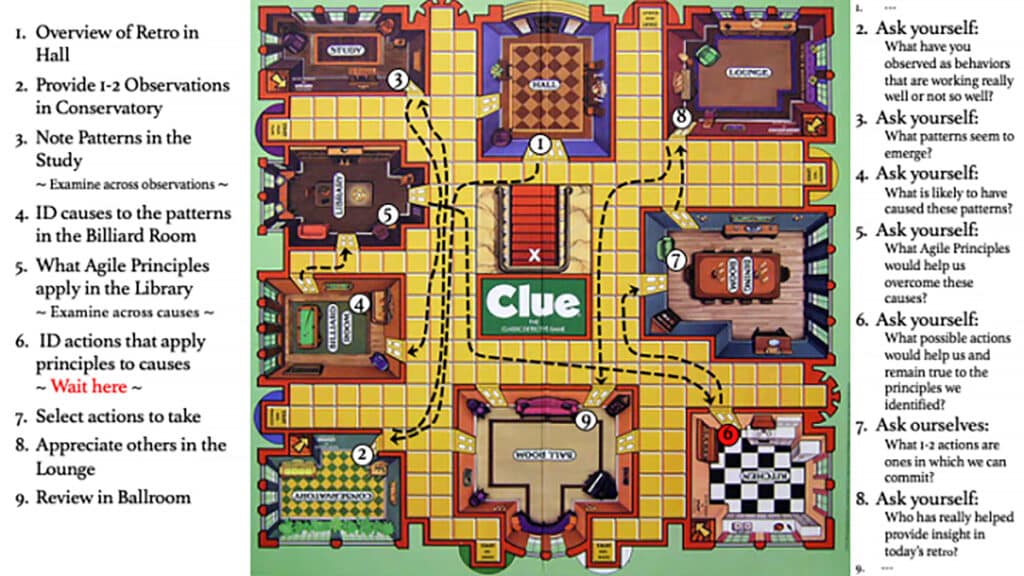
From the Hall, one goes to the conservatory. Here people post observations about what may be going well or not so well. Once they post 1-2, they can move to the Study considering what they posted and any other posts that other people made. In the Study, they should consider patterns from the observations. For example, perhaps they notice a pattern of poor communications followed by a system failure or a pattern of the team celebrating people’s learnings at stand-ups. After posting patterns they saw, they can move to the Billiard Room where they think about the causes behind the patterns. Perhaps it is having a different understanding around words or the people having different levels of knowledge in the poor communications leading to system failure pattern.
Once causations have possibly been identified, people can move to the Library. I usually have a link to the Agile Principles at agile manifesto.org or have this posted physically if in a physical environment. The idea is for people to think about which principles may apply to the causations. Then it is off to the Kitchen, where people think of actions or experiments to do using the Agile Principles to help amplify causations for ‘good’ stuff or dampen/eliminate causations for ‘bad’ stuff.
People iterate through the rooms as they see fit as others add observations and patterns new causations may emerge, additional Principles to use, or additional actions. I ask people when they feel they have exhausted coming up with ideas to simply wait in the Kitchen.
Now it is time to select the actions we want to eat as a team. What will be served in the Dining Room? You could dot-vote if you wanted, but I have found teams figure 2-4 they want to have as their meal. If actions feel a little incomplete, but something the team wants to do, encourage them to be fleshed out a little. How do we know when they are complete or successful? Who will lead the action?
Once you have selected the actions you want (and flesh them out if needed) in the Dining Room, move to the Lounge, where people offer appreciation for contributions, insights, ideas, etc. that others made in the retrospective.
Close the retrospective by going to the Ballroom to recap the actions to be taken, where they will be posted for update, and to celebrate.
If you try this out, please comment on how well it worked. Download the picture above as a background for Mural, Miro, or some other tool. (I first used PowerPoint online.)