
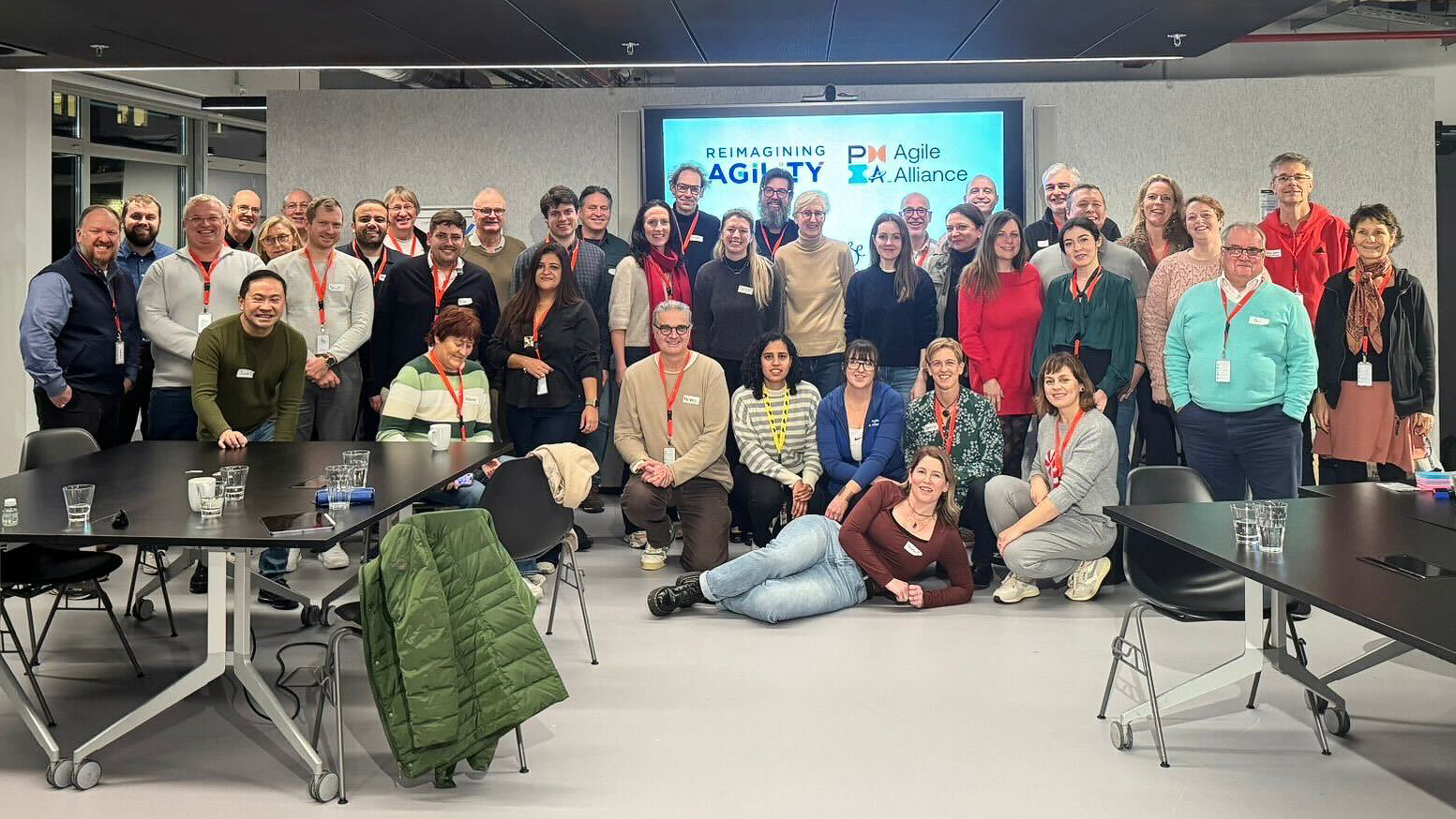
On 12 December, 2025, around 50 practitioners and leaders gathered in Hilversum, The Netherlands, with a shared feeling that something in the Agile conversation had stalled. Agile practices are widespread, certifications abound, and yet many organisations seem to be experiencing more control with less learning, and growing fatigue rather than adaptability. Instead of introducing another model or defending past approaches that once helped, this workshop created space to pause and ask more uncomfortable questions: what have we lost along the way, what tensions are we no longer naming, and what might agility need to become in a world shaped by scale, governance, and AI?
The session was co-organised by local practitioners together with members of the Agile Alliance Supporting Agile Adoption initiative, and facilitated by Jeannie Flynn. Rather than a conference or panel discussion, the afternoon was structured around small, self-directed groups working on “wicked problems” (the kinds of challenges that don’t have clear owners or clean solutions). Over four hours, participants explored themes ranging from leadership and scaling to governance, innovation, and the impact of AI, capturing their thinking on walls and posters to make sense of what’s actually happening in organisations today.
What patterns showed up across the room
Across the conversations, a consistent pattern emerged: many of the tensions now attributed to “Agile” sit outside the reach of teams, frameworks, or roles. Participants repeatedly surfaced mismatches between speed and learning, strategy and behaviour, governance and value, human judgement and automation, short-term delivery and long-term intent. In several groups, frameworks, scaling approaches, and past Agile adoptions were described as having, at times, simplified complex problems, sometimes turning principles into rules and learning into compliance. The shared insight wasn’t that leadership failed agility, but that agility was often asked to operate inside unresolved organisational constraints. As these constraints become impossible to ignore, looking away (or worse, hiding behind Agile) is no longer an option.
What follows is a snapshot of what participants chose to explore.
Creating Agile leadership & culture
People in this group questioned whether organisations are still being run as machines, while expecting people to behave as if they were part of a values-based system. They named authoritarian leadership not as a personality flaw, but as a reaction to threat, reinforced by a gap between leaders and doers and deeply held assumptions about what “good management” looks like. Agility, they argued, requires leaders at all levels to shift from designing work to developing people’s capability, creating spaces to learn how to deal with uncertainty and to be explicitly judged on becoming wiser tomorrow than today.
Fostering innovation & continuous learning
This group surfaced what they experienced as a fundamental mismatch: organisations celebrate speed and delivery, while crowding out learning and innovation. Innovation was mapped across time (from cash cows to new ideas), showing how short-term pressure, top-down decisions, budget, fear, risk, and being “too busy” repeatedly block progress. Rather than calling for more process, the group pointed to an entrepreneurial mindset, lightweight frameworks, and the explicit balancing of discovery, delivery, and product as ways to keep innovation alive – suggesting that innovation doesn’t disappear as organisations scale; it gets deprioritised.
Scaling Agile across organisations
This group explicitly rejected the idea that scaling is a solution in itself. “Scrum is designed for teams,” they noted, and scaling without first addressing mindset, culture, and context simply reproduces hierarchy while calling it Agile. They challenged one-size-fits-all approaches, pointing out that even within a single organisation, contexts differ. And language matters! Rather than focusing on scaling frameworks, the conversation shifted toward shared principles, coherent steering, and first steps that create satisfaction and vision, because without those, resistance is the predictable outcome.
The future of frameworks
People in this group argued for a clear inversion: guidelines over frameworks, pragmatism over dogma, co-creation over enforcement, and evolution over stagnation. Frameworks were positioned as a starting frame, not a fixed future – useful only insofar as they enable learning and adaptation. One provocation was explicit: when frameworks stop evolving and start being enforced, they move from enabling agility to actively limiting it.
Aligning Agile with business value & governance
Here, the conversation challenged the idea that governance is the enemy of agility, arguing instead that the real problem is confusion: governance, compliance, risk management, and legislation are repeatedly conflated. They surfaced a lack of shared definition of both governance and business value, alongside a disconnect between delivery teams and those setting governance constraints. Rather than bypassing governance, the focus shifted to making decision-making, rules, measures, and value explicit, and to sharing real success and failure stories – suggesting that agility breaks down not because of governance, but because its purpose and value are poorly understood.
AI and automation
This group framed the next 1–3 years as a shift toward human + AI collaboration, not automation replacing people. The conversation moved deliberately from the individual (“how will my role change?”) to teams revisiting how they collaborate, and then to organisational change management. Trust, safety, data management, security, and ethics surfaced as non-negotiables. Rather than rewriting Agile, the group returned to the Agile values, arguing that as processes speed up and tools proliferate, individuals and interactions (trust, experimentation, customer collaboration, and responding to change) become even more critical.
Bridging Agile and traditional project management
This group framed the tension not as Agile versus project management, but as a disconnect between strategy and behaviour. Two questions dominated: “What’s our strategy?” and “What’s our mindset or behaviour?” – suggesting that without alignment on intent and how people act, neither Agile practices nor project controls can close the gap. The provocation was clear: integration fails not because of methods, but because strategy and behaviour are treated as separate conversations.
The impact of AI on leadership
This group questioned whether AI changes how leaders work, or whether it fundamentally changes what leadership is. They surfaced a distinction between formal authority, decision rights, and leadership, asking what remains human work when tasks, information, and recommendations are increasingly automated. As AI takes over coordination, analysis, and execution, some leadership activities may disappear, while others emerge: sense-making, ethical judgment, cultivating human connection, setting boundaries, and shaping shared context. The provocation was explicit: AI doesn’t just support leadership – it may redistribute power, redefine decision-making, and force leaders to let go of certainty.
Where this leaves us
Reimagining Agility wasn’t about finding answers or even agreeing. It was about creating space to surface tensions that many people are already living with but rarely get time to explore together. What emerged wasn’t a roadmap, but a reminder: these conversations don’t belong to conferences, consultants, or certification bodies. They belong with practitioners, leaders, and teams willing to sit with complexity and learn in public.
Keep the conversation alive!
Sign up to stay connected, and let us know if you’d like to host a similar Reimagining Agility workshop in your area. Learn more now.