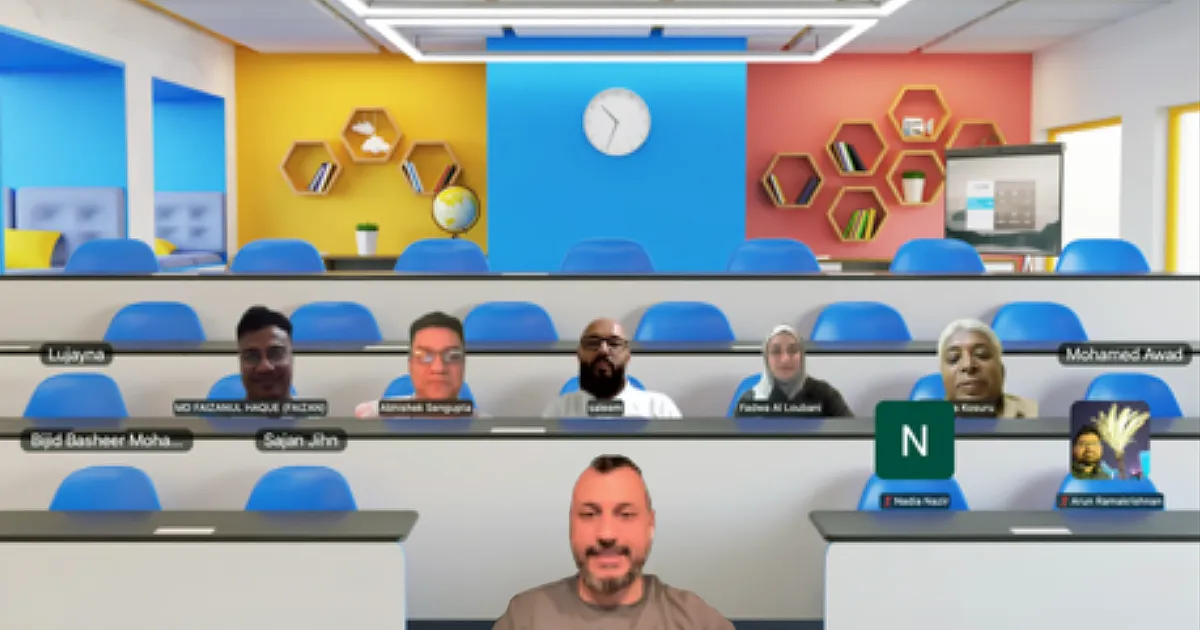
We had the pleasure of facilitating a Reimagining Agility Workshop with the PMI UAE Chapter. The session brought together 16 participants from diverse backgrounds, experiences, and maturity levels. This diversity turned out to be one of the workshop’s greatest strengths.
Rather than trying to cover everything, the group collectively selected two focus topics that felt both urgent and relevant:
- AI & Automation
- The Future of Frameworks
What emerged was not a discussion about tools or buzzwords, but a deep, human-centered conversation about mindset, roles, and decision-making in an AI-augmented world.
Agile as a mindset before a framework
One of the most valuable observations came from participants who were new to Agile and had limited hands-on experience.
Instead of immediately asking “Which framework should we use?”, their strongest takeaway was:
Agile is first and foremost a mindset, rooted in adaptability and learning.
This was a powerful reminder. Often, experienced practitioners jump quickly into frameworks, roles, and ceremonies. Seeing Agile through the eyes of newcomers reinforced something fundamental:
Starting with mindset and adaptability is not a weakness; it is a very healthy entry point.
This perspective aligns strongly with the idea of Reimagining Agility: moving away from rigid adoption models and toward contextual, purpose-driven agility.
AI & automation: Role anxiety is real
The most intense and emotionally charged conversations emerged around AI and its impact on roles.
A recurring theme was the uncertainty felt by project managers, Agile coaches, and Scrum masters:
- What will my role look like after AI?
- Will AI replace me, or support me?
- How do I stay relevant?
The group strongly agreed on one point:
Organizations have a responsibility to reduce this anxiety
AI should be positioned clearly as an enabler, not a silent replacement. Companies need to:
- Clarify evolving role expectations
- Encourage experimentation with AI
- Explicitly state that human judgment, facilitation, and leadership still matter
Without this clarity, resistance to AI adoption is not a technology problem; it’s a trust problem.
Data readiness and the limits of automation
Another critical discussion centered on data.
Participants highlighted that:
- AI is only as good as the data it is trained on
- Poor or incomplete data can lead to wrong decisions
- Hallucinated outputs are a real risk, especially in complex project contexts
A concrete example was discussed:
When writing an RFP, AI can help structure, draft, and accelerate the work, but it cannot fully automate it yet.
Until data quality and governance are mature enough, human review and judgment remain essential. The message was clear:
- AI can support decision-making
- It cannot replace accountability
Business focus and realism in project management
The workshop also surfaced an important shift in expectations for project managers.
In an AI-supported environment, project managers are expected to be:
- More business-oriented
- More realistic and outcome-focused
- Less focused on mechanical reporting, more on sense-making
This reinforces the idea that AI will automate tasks, not thinking. The value of project management increasingly lies in contextual judgment, stakeholder alignment, and business understanding.
Roles, reviews, and responsible AI use
A strong consensus emerged around one principle:
AI cannot be used effectively in isolation from clear roles and review mechanisms.
Even with advanced automation:
- Roles still matter
- Reviews are still necessary
- Human oversight remains non-negotiable
Rather than removing people from the loop, AI shifts where and how humans add value.
The future of frameworks: Adapting, not copying
In the Future of Frameworks discussion, the group explored how Agile principles apply beyond software development.
Particularly in construction and hardware projects, participants emphasized that:
- Sprint lengths must be adapted to the nature of the work
- Traditional project plans and Agile concepts can and should coexist
- A hybrid, context-aware approach is often more realistic than pure framework adoption
The key insight was not about choosing Agile vs. project management, but about integrating concepts in a way that serves the work.
Adaptive and hybrid approaches: One size does not fit all
Within the Future of Frameworks discussion, a strong emphasis was placed on adaptability and the intentional use of hybrid methods based on the nature and direction of the project.
Participants highlighted that different phases of a project often require different delivery approaches:
- Early phases, such as project initiation, contracting, budgeting, and governance, tend to benefit from a more predictive approach. Clear scope definition, contractual clarity, and upfront planning remain critical in these stages.
- Implementation and product development phases, on the other hand, are far more effective when handled through adaptive, sprint-based ways of working, enabling learning, feedback, and incremental value delivery.
Rather than forcing a single framework end-to-end, the group strongly agreed that:
The real skill lies in consciously combining predictive and adaptive practices based on context.
This perspective moves the conversation away from “Which framework is right?” toward “Which approach fits this phase, this risk profile, and this business need?”
Using AI to enable adaptive frameworks
The group also discussed how AI can actively support adaptive and hybrid frameworks when used responsibly.
Examples included:
- Supporting planning and scenario analysis during predictive phases
- Helping teams analyze progress, risks, and dependencies during sprint-based delivery
- Assisting decision-makers by synthesizing data across both project plans and iterative delivery metrics
However, the same principle applied here as well:
AI supports adaptation — it does not replace human judgment.
Clear roles, strong review practices, and reliable data remain essential, especially when navigating between predictive and adaptive modes of working.
Closing the loop with AI: From ideas to shared outcomes
To close the workshop, we intentionally used AI as a collaboration enabler, not just a discussion topic.
During the session:
- All ideas, insights, and reflections were captured and transferred into a shared digital workspace
- An AI-supported synthesis was used to cluster themes and highlight patterns across the discussions
- The most impactful idea was selected with the support of AI, based on relevance and collective emphasis
- Finally, an AI-generated summary was created and shared with all participants
I developed this AI tool used during the workshop while working as a volunteer on our Value Delivery Team, and it serves a broader purpose beyond this single session.
All outputs from Reimagining Agility workshops are continuously collected in this shared platform, enabling:
- Cross-workshop learning
- Pattern recognition across different communities
- A growing, living knowledge base shaped by practitioners
This closing step reinforced a key message from the workshop itself:
AI is most powerful when it enhances collective intelligence and transparency.
Rather than replacing human interaction, AI helped us:
- Create alignment
- Preserve shared understanding
- Extend the value of the conversation beyond the workshop room
In many ways, this final step embodied the spirit of Reimagining Agility, combining human insight, adaptive thinking, and responsible AI usage to learn faster and move forward together.
Final reflection
This workshop reinforced why Reimagining Agility matters.
- Agile is not a checklist
- AI is not a replacement
- Frameworks are not universal solutions
Agility lives at the intersection of mindset, data, roles, and context.
And meaningful progress happens when we create safe spaces to question assumptions, exactly what this workshop enabled.
A big thank you to the PMI UAE Chapter community for the openness, curiosity, and depth of discussion. The conversation has only just begun.