AGILE GAMES

Thirty-Five

AGILE GAMES

Thirty-Five

Timing:

10-15 minutes

Materials:

A minimum of 8 people, and an even number of people

Anything that you want to prioritise, written on separate cards

One card and one pen per person

Instructions:

This exercise only works with an even number of people and has a total of seven rounds

Give everybody a card with a Product Backlog item on it and a pen

In each round, everyone finds someone to pair up with and they discuss the two cards they have in front of them:

  • As a pair, you have 5 points that can be allocated between the two cards based on the relative importance of the two cards
  • No half-numbers are allowed so the points must be split 5:0 or 4:1 or 3:2
  • It is not about each person trying to convince the other that their card is more important than their partner’s card
  • The two people must agree on the scoring split
  • Once the scoring split has been agreed, the pair swap cards with each other and hold their hands up to indicate they have finished the round
  • Once everyone has finished with the round, the facilitator indicates the start of the next round where different pairings will take place, repeating the above process
  • A total of seven rounds are run and then the total of the 7 scores on the card are totaled up.
  • The cards are then laid out in order with the highest-scoring cards at one end and the lower scoring cards at the other

Learning Points: 

  • It is easier to prioritise when only comparing two items
  • It is a quick way to prioritise
  • It is a democratic, inclusive process
  • If you have stakeholders who are attached to lobbying for one particular feature, this literally requires them to give it away to someone else

Variations:

  1. Try more rounds to decrease the likelihood of spurious results and cards with the same total score
  2. Try a bigger scoring range to increase the spread and reduce the impact of people unwilling to use the extremes i.e. 9 points instead of 5. While you may still not get many 9:0 you may get more 7:2’s
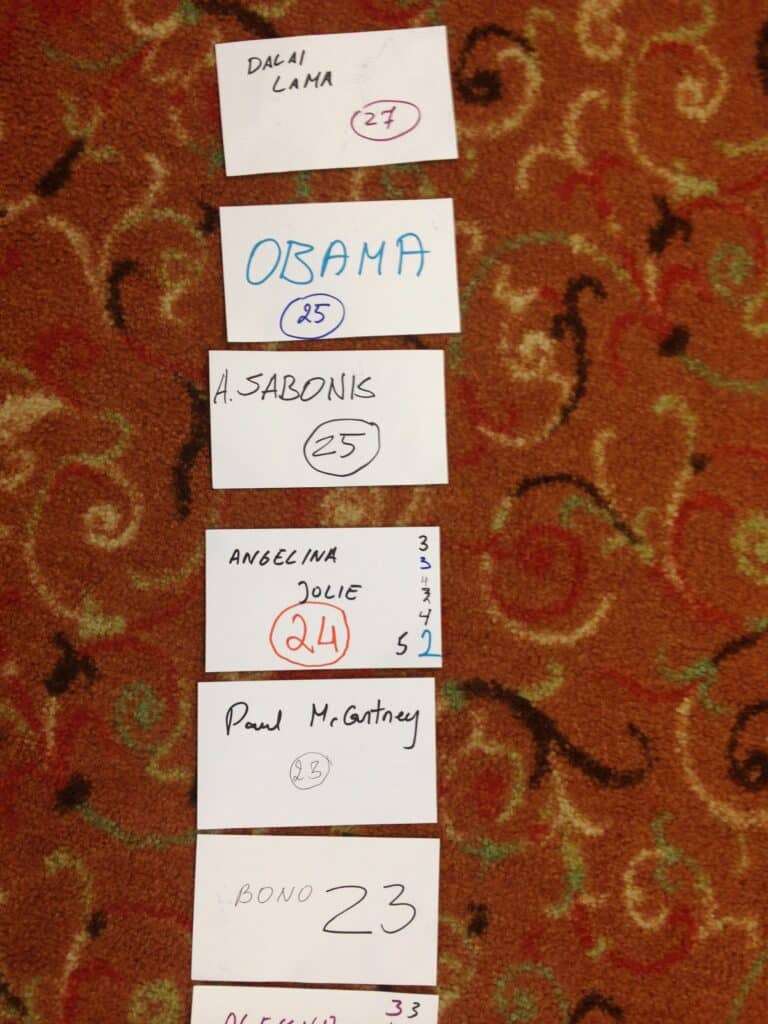
I was introduced to this technique by Xavier Quesada Allue who told me he learned it from Tobias Mayer. A reference to this can also be found in Jean Tabaka’s book: Collaboration Explained (p207) entitled “Pass The Cards”

About Tasty Cupcakes

This content was originally published on Tasty Cupcakes, a community-run website founded by Michael McCullough and Don McGreal after they presented a series of games at Agile2008 in Toronto. The site’s tagline was “fuel for invention and learning.” After 15 years at TastyCupcakes.org, the content has found a new permanent home here at Agile Alliance.

The games, techniques, and approaches presented are here to use and explore. All we ask is that you tell others about us and give us some feedback on the games themselves. All of this work is licensed under a Creative Commons Attribution 4.0 International License.

Got feedback? Join the conversation!

Explore additional Agile Games

A mindfulness exercise that helps us to take the stance of not knowing and to recognize how quickly we let ourselves be guided by our first impression. With this bias, we often miss the chance to explore alternatives and thus leave even much better s…
Timing 20-30 minutes Materials 1-pack of sticky notes pens for each group of 3-5 people dry erase board, table, window, or wall to set up the maze Instructions Explain to the audience that we're going to play a game that allows them to progra…
Each team (or organization) has 4 items (stories or projects) to complete. We will simulate these by placing suits of cards in order. Materials For every 5 people, you’ll need a deck of cards and a stopwatch that provides a means of capturing …
Timings: 5-10 mins Materials: 4 willing volunteers Instructions: One person plays "the interviewer" The other three people play the "interviewee". The only rule they must follow is that they must answer any questions one word at a time, in sequence.…

Ready to join Agile Alliance?

Unlock members-only access to online learning sessions, Agile resources, annual conference discounts, and more! And when you join, you’ll be supporting our member initiatives, regional events, and global community groups.

Privacy Preference Center

IMPORTANT: We have transitioned to a new membership platform. If you have not already done so, you will need to SET UP AN ACCOUNT on the new platform to establish your user profile. Your previous login credentials will not work until you do this set up.

When you see the login screen, choose “Set up Account” and follow the prompts to create your new account. You can choose to log in using your social credentials for either Google or Linkedin (recommended), or you can set up your account using an email address.